Saturday, August 5, 2017

Hope on the Horizon

There's a relatively new player in the game to take down the duopoly. As stated on its website, the Centrist Project is a grassroots organization dedicated to organizing Centrist Americans, supporting Centrist policies and encouraging more independent candidates to run for public office to put our country ahead of any political faction in order to solve problems.

I've attended a few meetings/calls with the group and I believe they have a good shot at making something happen. Here's why:
  1. Targeted strategy. Instead of making bland proclamations about changing the system for the better, the project is laser focused on demonstrating their fulcrum strategy here in CO by recruiting candidates for the 2018 state senate election. The idea is to demonstrate the strategy here to build attention and enthusiasm so they can replicate the strategy at the national level for 2020.  
  2. They've done their homework. The project chose CO based on data crunching to determine where the strategy would most likely be successful. Furthermore, they have looked at what are the biggest barriers for independent candidates and will marshal the organization towards surmounting those barriers. Once candidates are vetted and endorsed, the project will pore in resources from the national level to give these candidates the resources and boots on the ground to make up for their disadvantages not running on the duopoly ticket.
  3. Transparency. Unlike the failed Americans Elect, the Centrist Project appears to want to be transparent about their founders and therefore their intent. 
Not sure yet as to what extent I will get involved in the project for the next cycle, but I am excited by their prospects and hope you are too!

Thursday, February 2, 2017

Trump Downfall Betting Pool

As first mentioned in a FB post, I've put together a betting chart as to when and how Trump will no longer be the 45th president of the United States. Instructions on entering the pool are below. All fees go directly to the charity of your choice. I will donate the prize money.

The pool has been moved to a FB page:

https://www.facebook.com/Trump-Downfall-Betting-Pool-233181863810290/


Friday, December 23, 2016

Trump and the Populists – Historical Parallels and Opportunities for the Modern Left

As progressive folks continue to despair at the election of Trump, it’s important to put his upset victory over Clinton into historical context. Ironically, Trump’s win reflects a particular cycle in American history that can be characterized as “reform moments,” or historical eras when social movements arose in response to the excesses of capitalism to demand government action to rectify or compensate for market failures. The Trump presidency may in hindsight be viewed as an echo of this cycle, and represents an opportunity for progressives to shape the forthcoming reform moment.

Prior reform cycles in American history include the Populists (1890-1912), the Progressives (1912-1938) and the New Deal (1938-1945). Of these cycles, the one most similar to now is the collection of social movements and political campaigns broadly referred to as the Populist movement of the late 19th century. Driven largely by farmers in the mid-West and South, Populism was an agrarian revolt against the emerging corporate state of the gilded age and its creed of progress, and had the following characteristics similar to Trump’s campaign for the President:
1.       Economic crisis as antecedent
2.       Conspiracy as diagnosis (with racist overtones)
3.       Nostalgia as solution (through the exercise of state power)

Economic Crises as Antecedent
The period after the Civil War was marked by the expansion of industrialization, the creation of a national market, and the commercialization of the agriculture sector. Most farmers did enjoy a higher standard of living as a result of these changes, but often at the price of becoming heavily indebted to bankers, and farmers soon lost income and livelihood to the vagaries of the natural business cycle. This despondency reached its peak with the silver panic of 1893 when a crash in wheat prices led to a run on gold and then collapse of the financial sector. Thousands of businesses and banks closed, with upwards of 20% unemployment nationwide, and a significant number of farm and home foreclosures (Hicks 1988).

One need not look too hard to see the parallels with the Great Recession of 2008 when an overextended credit market combined with malfeasance led to another collapse of the financial system, followed by 10% unemployment, millions of home foreclosures, and a general downgrade in the standard of living for those most vulnerable to a credit crunch.

Conspiracy as Diagnosis
For those most directly affected by the economic crises of the late 19th century, the reason for the crises was a conspiracy of monied interests (railroads, banks, and trusts) over the common man, leading to “a struggle between the robbers and the robbed.” An unfortunate and often overlooked aspect (Hofstadter 1988) of the Populist’s conspiracy theory was an overtone of anti-Semitism, with many allusions to “greedy Jews” determined to take away the hard-earned income of a struggling working class.

For the downtrodden of today, it is a conspiracy of East-coast elites and the media shoving trade pacts, open borders, and other neoliberal policies down the throats of those least able to withstand the negative effects of globalization. The apparent threat posed by immigrants gives the current conspiracy theory its racist overtones, as displayed in both Trump’s claim of Mexican rapists overwhelming the border or the explicit endorsement of his presidency by white supremacists.  

Nostalgia as Solution
The Populists were generally not looking to the future, but to a past that seemed to be fading away, an agrarian utopia founded on Jefferson’s myth of the moral superiority of the yeoman, and a value system that saw commercialism as a polluting influence on civic society. To get back to this idyllic past, the Populists called for an expansion of government powers to protect the right of laborers to organize, to mandate an 8-hour workday, and to restrict immigration. Populists also called for the adoption of a progressive income tax, initiative and referendum mechanisms, direct election of senators, term limits on the President, and abolishing corporate subsidies.

Trump’s frequent promises to “bring the jobs back” by withdrawing from trade pacts, brow-beating corporations, and other protectionist and anti-market policies are driven by nostalgia for a time after the second world war when most anyone without a college degree could secure nearly lifetime employment in the manufacturing sector, providing a comfortable if not prosperous standard of living. It is believed this “manufacturing utopia” can be brought back through state power to restrict immigration and otherwise disengage from the global marketplace.

The Populists Legacy and Looking Ahead
Though the Populists did not succeed as an independent political force, many of the reforms that originated with them were later enacted, taming some of the excesses of the gilded age. More importantly, the Populists laid the groundwork of a “movement culture” (Goodwyn 1988) that later-day activists across the ideological spectrum would build upon to push for political and social change. On the flip side, the racist parallels between the Populists and the Trump campaign demonstrates that there is still work to be done to overcome structural racism.

The take-home message for progressives today is that all is not bleak. The grievances that propelled Trump to the presidency are real, and even if his proposed solutions are mostly counter-intuitive to progressives, there is an opportunity here to harness these grievances to push for sustainable and effective change that will serve to correct the current imbalances in the system. And as recently pointed out elsewhere, the fight for racial justice can and should be considered a compatible goal with economic and political reforms.

References:
Goodwyn L. “Populism: Democratic Promise.” Conflicts and Consensus in Modern American History. Ed Davis A and Woodman H. 7th edition. DC Heath and Company, 1988. Lexington, MA

Hicks J. “The Farmer’s Grievances.” Conflicts and Consensus in Modern American History. Ed Davis A and Woodman H. 7th edition. DC Heath and Company, 1988. Lexington, MA.

Hofstadter R. “Populism: Nostalgic Agrarianism.” Conflicts and Consensus in Modern American History. Ed Davis A and Woodman H. 7th edition. DC Heath and Company, 1988. Lexington, MA.

Thursday, December 1, 2016

The 3 pillars of the duopoly

After another painful presidential election when voters were given a choice between two shades of the same oligarchy, it's time to revisit what reforms need to happen to dismantle the duopoly and give voters more choices at the polls and more possibilities for our system to better represent its citizens.

After looking through my prior posts regarding softball and hardball solutions, these 3 reforms I believe are the key ones that need to happen:

1. Declare that money is not speech and that corporations are not people. 
This is definitely a hardball solution as it will require amending the constitution. Thankfully, there is already a national, grass-roots organization working on this very idea. Move to Amend is doing a great job laying the groundwork that will be needed to pass an amendment because the only way it will happen is if ordinary people organize to overwhelm the oligarchy.

2. Create choice at the ballot box now
No 2 is between a hardball and softball solution in that it won't require an amendment to the constitution, but will require changes at the state level widespread enough to make a difference. There are many ways to create more choice at the ballot box now, but in my opinion, the quickest and most straight-forward is to push for ranked-choice voting, also called instant runoff voting. I'll let the experts at FairVote explain the concept. There is already movement on this issue as Maine just passed this very reform last month. One state down, 49 to go.

Some may point out that changing the electoral college should be the focus. Yes, changing the EC would create a better sense of fairness, especially as last month was the second election in recent times where the losing candidate won the popular vote. To me, changing the EC is just putting lipstick on the pig and our energy should be more focused on creating choice at the state level and that will percolate up to the EC in due time.

3. Open up ballot access for the long term
This last solution is a softball in that changes to ballot access are controlled through a myriad of state and local laws that can be changed on a local level, chipping away at the duopoly in the process. The high number of signatures required to be put on the ballot, the requirements of having a certain percentage of the vote in the previous cycle to be put automatically on the ballot for the next cycle, and other restrictions need to be fundamentally reformed or simply eliminated to open up the system to alternative parties. Signs of these reforms are sporadic at best and this one will take more time than the first 2 pillars to educate and organize.

The take home message is that stuff is already happening on knocking down these 3 core pillars of the duopoly and it re-energizes me to get back into the fight in the new year.

Friday, July 4, 2014

Duopoly Reform in Colorado

Happy Birthday America! 

Wonderful coincidence to also find out there are 3 initiatives trying to get on the ballot this November that will open up the primary process in a way to allow for more party choices. I would put this under the "softball" category of reforms as it does not address the fundamental barrier of single-district representation. Nonetheless, it is an excellent start. 

Initiative 112 is the most important one to bust the duopoly, but #113 and #114 would also serve to diminish the duopoly stranglehold on power. Below are the proposed ballot text from the group that is pushing these initiatives. As far as I can tell, the group is legit and not some corporate-funded sham.

Proposed Initiative 2013-2014 #112
Shall there be a change to the Colorado Revised Statutes concerning a two-round election system for federal and state offices, and, in connection therewith, replacing partisan primary elections with first-round balloting in which any eligible elector may vote; allowing the three candidates with the most first-round votes and any other candidate who earns at least 3% of the first-round votes to advance to the second-round general election regardless of party affiliation; conducting general elections by allowing voters to vote for and rank in order of preference up to three candidates per office; requiring tabulations until a candidate receives fifty percent of the votes; and specifying petition procedures for candidates?

Proposed Initiative 2013-2014 #113
Shall there be an amendment to the Colorado constitution concerning the use of registered voter political affiliation as a factor in determining the boundaries of legislative districts, and, in connection therewith, requiring each congressional district and state legislative district to include registered voters from the two largest political parties and unaffiliated registered voters in percentages that are as equal as possible to the respective percentages of such voters statewide and specifying maximum variances in such percentages of three percent for Congressional districts and six percent for state legislative districts?

Proposed Initiative 2013-2014 #114
Shall there be an amendment to the Colorado constitution concerning a non-partisan Secretary of State, and, in connection therewith, converting, effective January 2017, the office of Secretary of State from a partisan elected office with a four-year term to an appointed office with a six-year term filled by the governor subject to confirmation by the state senate, prohibiting the person so appointed from having been involved in partisan politics during the prior three years, requiring the secretary of state to act in a nonpartisan manner when discharging his or her duties and to refrain from engaging in certain political activities, and restricting the grounds on which the secretary of state may be removed?  

Saturday, October 26, 2013

Softball update: California's "2 past the post" primary system"

Among the softball solutions to the duopoly, changes to the primary election method seem the most promising way to enable more political competition. In 2012, California enacted an electoral reform called the open primary. The method (also used in LA and WA) allows whomever gets the 2 top spots in a primary (regardless of party affiliation) to be the 2 candidates that compete for the office at stake in the general election. 

As much as I applaud any effort to open up the electoral process, this reform only provides the appearance of greater competition. Beyond the awkward possibility of 2 candidates from the same party competing in the general election (which has already occurred), the open primary is flawed in that it assumes only 2 candidates are allowed to compete for 1 seat in the general election. In theory, anyone with enough energy and money can surpass the duopoly in the primary and win as an independent in the general election. However, due to institutional and cultural inertia, there is still too much incentive for only 2 parties to compete for that seat as it simply shifts the overwhelming money advantage of the duopoly from the general election to the primary. In the end, the open primary is limited by the single-member district model as instituted in the 1842 Apportionment Act and subsequent legislation.  

The solution to this conundrum? Ditching the single member district model in favor of proportional representation. This does not require a parliamentary system as there are plenty of ideas on how to create a more fair voting scheme than what we have now. The key will be creating the political will to make such reforms, which we know will not happen as long as the duopoly strangles the process as it is bankrolled by corporate interests. This brings me back to my current position that the best way forward is to amend the constitution to declare that corporations are not people and do not enjoy the same rights as humans. From there, we would have a realistic chance of passing the electoral reforms needed to rebirth our republic.


Friday, October 18, 2013

Revolution

The revolution that birthed this nation proclaimed a right to self-destiny. The civil war was the 2nd revolution, by proclaiming equality a necessary ingredient for liberty. The 3rd is upon us, as the private sector has usurped the political machinery to the point that it overshadows the state and drowns out civil society. The course we take from here will answer whether the collective will can correct the cumulative greed of individuals.

Sunday, November 11, 2012

To Affliation and Beyond!

The organizing conference for MTA that I posted about in May was delayed until this weekend and I attended part of the Saturday session. Though turnout was low, it was great to meet some of the people for whom I only knew a name, and to be energized to get more involved. 

The next step will be drum up some interest in Longmont and then apply for an MTA affliation. Not sure yet if I'll try to just host a meeting, get some petitions signed, or something else. Either way, I am excited to use my prior grass-roots organizing skills and to be part of a movement for which I feel strongly about.

Stay tuned.


Thursday, November 8, 2012

Why Obama won

Though Obama's re-relection only extends the duopolistic control of our political system by the wealthy elite, it's worth examining the mechanics of why Obama's campaign operation was so successful:

1. Demographics is destiny: As the percentage of white voters in the electorate continues to decline, the math was against the republicans.

2. Superior ground game: after the 2008 election, the Obama campaign incorporated itself as a company to maintain and expand on the momentum of the previous election. The focus on early voting significantly favored the democrats, especially when a lot of that early voting occurred before the debates when systematic ad buys painted Romney as an uncaring plutocrat in battleground states.

3. We're not them: from Romney's 47% to Akin's legitimate rape, the republicans could not help but shoot themselves in the feet and piss off key voting blocs. 

That's my take. What do you think?

Saturday, October 27, 2012

Materialism = Sadism, part 1

In a prior post I mentioned the concept named in this post's title.

To elaborate requires some explanation.

First, a definition of terms.

Materialism is understood here as the accumulation of material goods, and as a consequence, status, prestige, power.

Sadism is understood here as 1 side of a duopoly towards sexual deviance, in that Sadism represents the willing subjugation of the lover, while masochism is the willing surrender. 

Second, responses to possible objections to the above definitions.

Though the Sadism/Masochism convention is typically treated as one of the more lurid theories of Sigmund Freud, this assumption about basic human behavior is telling in that it describes well how humans interact with other humans and with the world we live on. 

One could point out that materialism has always been seen as hedonistic, so materialism as sadism is not exactly seminal. True indeed, but our stated supposition, as will be shown, is an attempt to understand that relationship through an existential or ontological lens, with the moral consequences of materialism (expressed as hedonism) a secondary lens.

Third, the arguement.
 
To construct our existential lens we must dive into Jean Paul Sartre, a French existential philosopher from the mid-20 century. The link is to his bio, so I won't repeat here, other than to highlight how tragedies of the 1930s and 40s influenced his philosophy.

In Sartre's primary work, Being and Nothingness (1943), he posits that the sadism/masochism struggle can function as a means to negotiate the "Other" or as Sartre labeled it, the "being-in-itself."

We all negotiate Other as the primary means of relating with the world as a Self. It is the Self-Other dichotomy that drives much of human behavior, and sadism is a way to cope with Other by controlling or defining it (the flip-side being controlled or defined by Other). 

We can control or define Other by consuming it. By consuming Other, it disappears, and then no longer threatens to force us to face our "facticity (Sartre's term), or the fact that we are free to define our existence, and are therefore not free from having to do just that. And it's the knowledge that we are not free to to not define ourselves is what causes Sartre's "La Nausée".

Fourth, to circle round.
 
Consumption is essentially materialism.

Therefore, materialism equals sadism.

Thursday, September 20, 2012

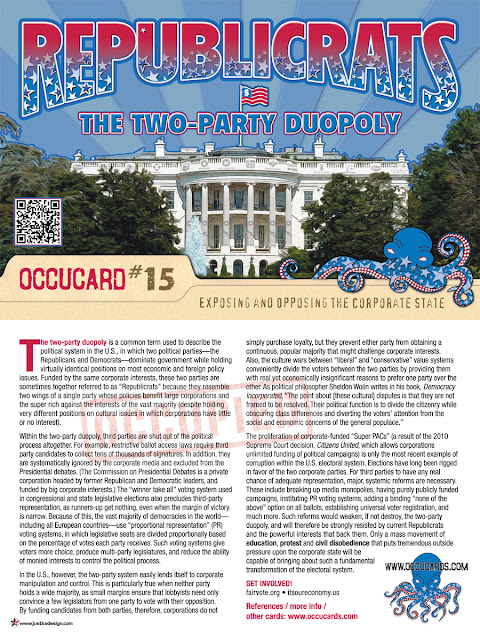
Duopoly Gets More Attention from Occupy

The occupy movement publishes a series of information cards called "Occucards" and now there's one on the subject of the political duopoly in this country.

 
I'm super psyched about this and have already ordered copies to start leaving anoymously in random places and may be change a few minds.

Sunday, August 5, 2012

Materialism = Sadism

In response to a recent topic post for a local philosophy group that I've participated in before:


My response (as I was not able to attend in person):

The Original Position question is a tough one as it seems almost impossible to think about who I am without knowing what my social structure (or what Marx called the "superstructure") is or will be. And to then posit what would be your ideal superstructure without knowing who you are as a person becomes impossible using this logic. Do you see the paradox?

Leaving that objection aside, my ideal superstructure would be one where there is less value on materialism or material wealth. Of course, such an ideal is really a reaction to the current, real superstructure we live in today, but I think such an ideal goes deeper than simple anti-materialism, in that materialism is on a certain level, a form of sadism, and sadism is bad for the soul." 


I'll post later what I mean by the posit: materialism=sadism.


Sunday, May 13, 2012

Why Americans Elect Won't Amount to Much

A recent Time magazine commentary (Indie Block) discusses why the third-party presidential nominating organization Americans Elect (AE) has not made the splash that was hoped when it announced its intention last July to nominate a centrist candidate in all 50 states using a web-based, non-partisan nominating process. The commentary claims that AE's lackluster performance is due to a lack of differentiation, as there are already 2 centrists in Romney and Obama, and that the 2 parties are actually talking about the issues that polls indicate matter to voters, so there's not enough frustration to give AE some wind. Beyond the nauseating apologist deference toward the duopoly, the article also has the wrong diagnosis. 

The reasons that AE is not successful are two-fold:

1. Lack of transparency. AE will not reveal its donor list, claiming its to protect donors from retribution by duopoly agents. No doubt there's a possibility of retribution, but it still leaves one wondering if this not another front group like MoveOn.org. That fact that both MoveOn and AE are organized with top-down structures further paints AE as more a co-opter rather than a co-revolter.

2. Playing by the rules instead of changing them. AE has the mula to overcome the inherent barriers to ballot access instituted by the duopoly, and that is the main reason it has gotten as far as it has. Instead of questioning these laws (it could use its funds to challenge ballot access laws in court instead of spending its way past them), AE just wants to expand the duopoly to a triopoly. No wonder folks are not biting.

The fact that even insiders are disgusted enough with the duopoly to attempt something like AE is a symptom of system ripe for change, but its strategy only reifies a dying structure.

Friday, May 4, 2012

Convincing Conservatives To Support MTA

As relayed in previous posts, I have become more involved with the group Move To Amend (MTA), and plan to attend a regional organizing conference later this month. The group's proposed amendment to the US Constitution would firmly clarify that corporations do not carry the same self-evident rights as natural persons. 

MTA has been successful so far generating interest and support for the movement, but this enthusiasm has been largely confined to the political left of the country. If the movement does not reach out to more conservative crowds, passage of this amendment will be extremely more difficult and perhaps doomed to someone's footnote.

Here are 2 major arguments for conservatives why they should support this amendment as written:
  1. The "money is not speech" clause will not only affect corporations, but also labor unions. They too would no longer have a constitutional right to spend freely to influence political elections. It means any flushing of money from the system engendered by this amendment will be equally painful for both major parties, and more likely to enable greater party competition that would better represent the diverse views of conservatives (and liberals) alike.
  2. Restricting the ability of corporations to influence government policy will make government smaller. The expansion of government has been caused as much by corporate mercantilism as it is by bureaucratic inertia and legislative best intentions.
No doubt other arguments could be made, and the 2 above seem like a good place to start. Now I must convince others in MTA on these points.

Friday, February 17, 2012

Dump the Duopoly: Soft Ball Solution Update

There appears to be movement on changing how electoral college votes are allocated as I had suggested in my list of softball solutions to the duopoly. A number of states (9 in all, representing 49% of all electoral votes) have already committed to allocating their electoral college delegates to the candidate that wins the national popular vote in 2012. Though this change will not necessarily enable more competition, it will make every person's vote actually count and not be simply discarded due to the "winner-take-all" method created and enforced by the duopoly. In the long-run, this is also an important change because it will raise expectations for electoral reforms, opening the way to implement other, logical reforms to destabilize the duopoly, such as choice voting.

Saturday, November 12, 2011

Dump the Duopoly: Hard Ball Solution Update

It seems what I first saw as an improbable hard ball solution to the Duopoly is now starting to become more realistic. It seemed farfetched to believe we could overturn (through a constitutional amendment) the recent string of US Supreme Court decisions regarding the definition of speech and ultimately, of person hood. Recent victories with municipal-level resolutions have given some life to the idea that we can not only take money out of the equation for elections (as an ultimate goal), we could also redefine the relationship between our government and the private sector. It's time to re-balance that relationship and MovetoAmend has this drive to amend the constitution in this manner as one of its primary goals. An aggressive goal now would be to go for resolutions (through ballot initiative) on an even bigger level, such as state. Would it be possible to get it on the ballot in Colorado for the next presidential election? For it to even get on the ballot would be a victory in my mind, then we'll just get the media shined on it, and that will hopefully start a national conversation on the subject. 

Anyone in?@!