The organizing conference for MTA that I posted about in May was delayed until this weekend and I attended part of the Saturday session. Though turnout was low, it was great to meet some of the people for whom I only knew a name, and to be energized to get more involved.
The next step will be drum up some interest in Longmont and then apply for an MTA affliation. Not sure yet if I'll try to just host a meeting, get some petitions signed, or something else. Either way, I am excited to use my prior grass-roots organizing skills and to be part of a movement for which I feel strongly about.
Stay tuned.
Sunday, November 11, 2012


Thursday, November 8, 2012
Why Obama won
Though Obama's re-relection only extends the duopolistic control of our political system by the wealthy elite, it's worth examining the mechanics of why Obama's campaign operation was so successful:
1. Demographics is destiny: As the percentage of white voters in the electorate continues to decline, the math was against the republicans.
2. Superior ground game: after the 2008 election, the Obama campaign incorporated itself as a company to maintain and expand on the momentum of the previous election. The focus on early voting significantly favored the democrats, especially when a lot of that early voting occurred before the debates when systematic ad buys painted Romney as an uncaring plutocrat in battleground states.
3. We're not them: from Romney's 47% to Akin's legitimate rape, the republicans could not help but shoot themselves in the feet and piss off key voting blocs.
That's my take. What do you think?
Saturday, October 27, 2012
Materialism = Sadism, part 1
In a prior post I mentioned the concept named in this post's title.
To elaborate requires some explanation.
First, a definition of terms.
Materialism is understood here as the accumulation of material goods, and as a consequence, status, prestige, power.
Sadism is understood here as 1 side of a duopoly towards sexual deviance, in that Sadism represents the willing subjugation of the lover, while masochism is the willing surrender.
Second, responses to possible objections to the above definitions.
Though the Sadism/Masochism convention is typically treated as one of the more lurid theories of Sigmund Freud, this assumption about basic human behavior is telling in that it describes well how humans interact with other humans and with the world we live on.
One could point out that materialism has always been seen as hedonistic, so materialism as sadism is not exactly seminal. True indeed, but our stated supposition, as will be shown, is an attempt to understand that relationship through an existential or ontological lens, with the moral consequences of materialism (expressed as hedonism) a secondary lens.
Third, the arguement.
To construct our existential lens we must dive into Jean Paul Sartre, a French existential philosopher from the mid-20 century. The link is to his bio, so I won't repeat here, other than to highlight how tragedies of the 1930s and 40s influenced his philosophy.
In Sartre's primary work, Being and Nothingness (1943), he posits that the sadism/masochism struggle can function as a means to negotiate the "Other" or as Sartre labeled it, the "being-in-itself."
We all negotiate Other as the primary means of relating with the world as a Self. It is the Self-Other dichotomy that drives much of human behavior, and sadism is a way to cope with Other by controlling or defining it (the flip-side being controlled or defined by Other).
We can control or define Other by consuming it. By consuming Other, it disappears, and then no longer threatens to force us to face our "facticity (Sartre's term), or the fact that we are free to define our existence, and are therefore not free from having to do just that. And it's the knowledge that we are not free to to not define ourselves is what causes Sartre's "La Nausée".
Fourth, to circle round.
Consumption is essentially materialism.
Therefore, materialism equals sadism.
Thursday, September 20, 2012
Duopoly Gets More Attention from Occupy
The occupy movement publishes a series of information cards called "Occucards" and now there's one on the subject of the political duopoly in this country.
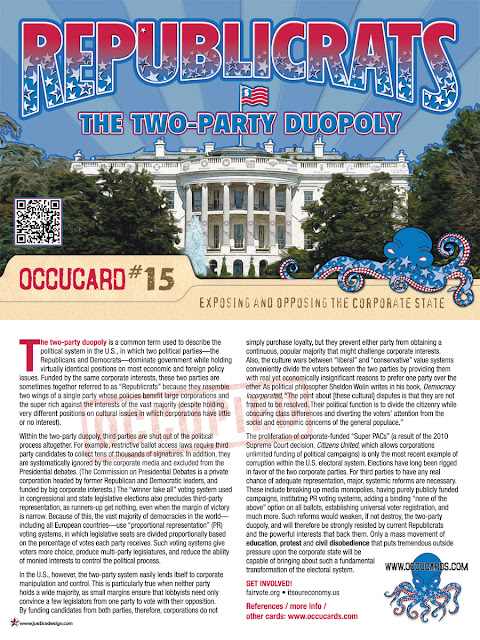 I'm super psyched about this and have already ordered copies to start leaving anoymously in random places and may be change a few minds.
Sunday, August 5, 2012
Materialism = Sadism
In response to a recent topic post for a local philosophy group that I've participated in before:
 Source Link
My response (as I was not able to attend in person):
Leaving that objection aside, my ideal superstructure would be one where there is less value on materialism or material wealth. Of course, such an ideal is really a reaction to the current, real superstructure we live in today, but I think such an ideal goes deeper than simple anti-materialism, in that materialism is on a certain level, a form of sadism, and sadism is bad for the soul."
I'll post later what I mean by the posit: materialism=sadism.
Sunday, May 13, 2012
Why Americans Elect Won't Amount to Much
A recent Time magazine commentary (Indie Block) discusses why the third-party presidential nominating organization Americans Elect (AE) has not made the splash that was hoped when it announced its intention last July to nominate a centrist candidate in all 50 states using a web-based, non-partisan nominating process. The commentary claims that AE's lackluster performance is due to a lack of differentiation, as there are already 2 centrists in Romney and Obama, and that the 2 parties are actually talking about the issues that polls indicate matter to voters, so there's not enough frustration to give AE some wind. Beyond the nauseating apologist deference toward the duopoly, the article also has the wrong diagnosis.
The reasons that AE is not successful are two-fold:
1. Lack of transparency. AE will not reveal its donor list, claiming its to protect donors from retribution by duopoly agents. No doubt there's a possibility of retribution, but it still leaves one wondering if this not another front group like MoveOn.org. That fact that both MoveOn and AE are organized with top-down structures further paints AE as more a co-opter rather than a co-revolter.
2. Playing by the rules instead of changing them. AE has the mula to overcome the inherent barriers to ballot access instituted by the duopoly, and that is the main reason it has gotten as far as it has. Instead of questioning these laws (it could use its funds to challenge ballot access laws in court instead of spending its way past them), AE just wants to expand the duopoly to a triopoly. No wonder folks are not biting.
The fact that even insiders are disgusted enough with the duopoly to attempt something like AE is a symptom of system ripe for change, but its strategy only reifies a dying structure.
Friday, May 4, 2012
Convincing Conservatives To Support MTA
As relayed in previous posts, I have become more involved with the group Move To Amend (MTA), and plan to attend a regional organizing conference later this month. The group's proposed amendment to the US Constitution would firmly clarify that corporations do not carry the same self-evident rights as natural persons.
MTA has been successful so far generating interest and support for the movement, but this enthusiasm has been largely confined to the political left of the country. If the movement does not reach out to more conservative crowds, passage of this amendment will be extremely more difficult and perhaps doomed to someone's footnote.
Here are 2 major arguments for conservatives why they should support this amendment as written:
- The "money is not speech" clause will not only affect corporations, but also labor unions. They too would no longer have a constitutional right to spend freely to influence political elections. It means any flushing of money from the system engendered by this amendment will be equally painful for both major parties, and more likely to enable greater party competition that would better represent the diverse views of conservatives (and liberals) alike.
- Restricting the ability of corporations to influence government policy will make government smaller. The expansion of government has been caused as much by corporate mercantilism as it is by bureaucratic inertia and legislative best intentions.
Subscribe to:
Posts (Atom)